


THE REAL
COMIC WORLD
I grew up in the 1970s, in a Dutch village that never seemed to let go of autumn. There was always wind and rain. My brother and I played in the reed bed near Lake IJsselmeer. We built huts there and dug traps for other children. Sometimes, armed with wooden shields and swords, we'd march along the dike crest to another village to settle a dispute.
Other than that, there wasn't much to do.
At one point, my father took us to the village hall. There, a room had been converted into a library. This was a revelation for me. The library wasn’t large, but it had plenty of books on the shelves, as well as large bins filled with comics.
My love for the comic world was born there, in that simple village library.

TIME

After that first encounter with the real comic world, it would take half a century before I made the leap to the Parallel Comic World...
Half a century!
There are things that come easily to us humans. There are also things that demand time. The plan to create an imaginary comic world demanded time. Somewhere in the background, the basic idea slumbered in my mind for decades. But the moment was never right. Or perhaps more accurately, I wasn't ready for it…
Designing a world is not like a trip to the supermarket, or doing a job for an advertising agency. I knew this would be an exceptionally ambitious project, requiring not only years of time and attention, but also skill, experience, and craftsmanship.
Do I currently have sufficient experience, skill, and craftsmanship? That question is difficult to answer. But the time has certainly come. And the choice has been made.

OUR CHOICES
SHAPE THE
WORLD
The Ukrainian Beresniak family decided to emigrate to France in 1905. That choice would have far-reaching consequences. Daughter Anna Beresniak met the young Polish engineer Stanislas Goscinny in Paris. They married, and two sons were born: Claude in 1920. And later, in 1926, René.
René Goscinny! Every comic book fan knows his name. Without him, we wouldn't have Asterix, nor Lucky Luke. And if the Ukrainian Beresniak family hadn't chosen to emigrate to France in 1905, we wouldn't have René Goscinny.
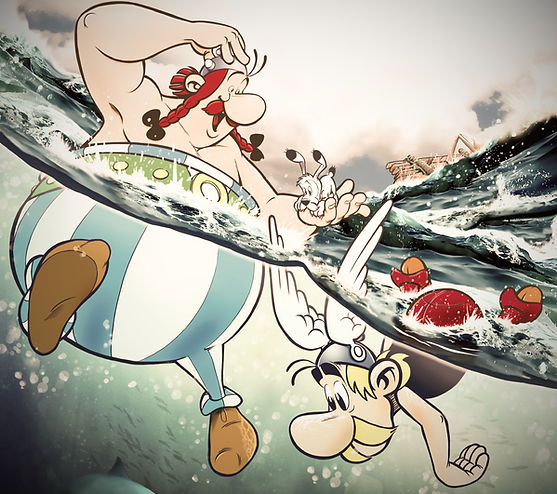
Our choices shape the world. Sometimes they are deliberate choices, and sometimes they are arbitrary, but they always shape the world. And that's what this project is about... Parallel Comic World is about the choices we make, and simultaneously, about the choices we don't make...
DEPARTURE

The choices we make determine the course of our lives, and the development of our world. If Mohammed Ali hadn't chosen boxing, he might have become a dog photographer, or a tour guide, or a living statue..
In the world of comics too, decisions shape the landscape: Hergé made choices that brought him to Tintin. Charlier and Giraud chose a path that led to Blueberry. And so, every comics creator makes a series of choices, which together result in a body of work.
The question that arises from this departure point is: what would have happened if the authors had made different choices? What -in that case- could the world of comics look like today?
There is no sensible answer to this question. We can at most guess, or put forward suggestions. And this last thing is basically what Parallel Comic World does. On this platform, suggestions are put forward. Parallel Comic World is—in essence—a representation of choices that were never made in the real world of comics.


FRAGMENTS
Just as a preview offers a glimpse into a forthcoming film, Parallel Comic World offers glimpses into the realms of an imaginary comic book world. The doors to that world don't open wide. The viewer is only given a taste, an appetizer. We peer through a peephole in the wall and see isolated fragments of a history that never actually occurred. We look at scenes, at covers, at pages. Sometimes, we see hardly more than chunks of an image.
Parallel Comic World offers openings. It offers snippets and shards, in which atmosphere, genre, and form come up, without the full arc of a story ever emerging. The viewer is invited to feel free. Free to pick up the propositions and to use his ingenuity, in order to construct possible storylines around the fragments.
Diversity is a key element in the collection. Just like in the real world of comics, we see a wide variety of styles and forms in Parallel Comic World.
Within the range, we see movements: from sloppy to polished, from caricatural to realistic, from bendable to rigid. Sometimes we see flowing graceful lines, like those of a brush, sometimes they are ragged, as if drawn with a worn-out pen. At times, the drawings feel guileless and naive, sometimes worldly and elaborate.
For the illustrator, working consistently in diverse, varying styles presents specific challenges. Phenomena like "muscle memory" and "visual memory" force the illustrator into the repetition of acquired routines. They force the artist to draw lines based on habits and automatisms, which easily leads to inconsistency in style.
In my work on the Parallel Comic World collection the above is always something I have to deal with, and over time turned out to be the biggest challenge in the project for me.
DIVERSITY
HOMOGENEITY
There are actors who seem effortlessly capable of playing a variety of characters. These people dissipate into their roles. You barely recognize them. They do not rely on a fixed 'type' or trick.
Christian Bale... Cate Blanchett... Daniel Day Lewis... Charlize Theron... Each and every one of them is as versatile as a Swiss Army knife. And the beauty is: this is recognized and appreciated. Within the acting world, versatility is considered something that belongs to the best in the business.
In music, we see a similar recognition. Singers with a wide vocal range are considered talented and awe-inspiring. Think of Bowie, Lady Gaga, or Freddy Mercury...


In the visual arts, it's different. The art market uses labels. Artists are ‘supposed’ to produce cohesive, homogeneous work. In other words: work that fits within a recognizable oeuvre. Stylistic leaps are rarely appreciated within that straitjacket.
This has presented me with a problem. The versatility, which is an important and indispensable element of Parallel Comic World, could within elite circles be interpreted as a lack of a clear signature.
To eliminate such views and criteria, I have -in addition to the versatility- established a structure in this project that ensures homogeneity. This structure needs no explanation here: it shows itself. It shows itself so clearly in fact, that if you would hang ten Parallel Comic World canvasses in an exhibition space with just one random other work, you would immediately recognize the odd one out.
THE PENCIL

The pencil forms the first breath of every drawing. Where brush and ink are decisive and binding, the pencil continues to listen. Doubt lingers in every line, and it is precisely there that beauty grows.
Honestly, I have always preferred looking at pencil sketches, rather than the same drawings in a final colored comic strip. In sketches, you sense the spirit of the creator. The pencil reveals the artist. Fragile traces alert us to hesitation. Firm strokes display the decisions that were made. Every drawing emerges from that exquisite symbiosis of graphite and paper.
And then, of course, there is the lighthearted liberty.. The noncommitment.. Nothing in Parallel Comic World is final. Nothing is finished. We look at fragments, at fleeting glimpses. The pencil seamlessly connects with that exploratory concept. The pencil knows no obligations, demands no perfection, only attention, openness, and patience. From a simple point, a world is born.

SIZE
The first time I found myself high in the mountains, I was struck by the overwhelming presence of nature. The grand dimensions and commanding panoramas left a deep impression on me, one memory that has never let go.
Our brains are wired to recognize relevance in our surroundings. Large objects easily catch the eye in that proces. They claim space and dominate the visual field. We remember them more vividly than smaller things. A cathedral is more intimidating than a hiking hut, and a whale inspires more awe than a stickleback.
With all this in mind, I decided to give Parallel Comic World a considerable scale. It seemed not only meaningful, but also invigorating. After a lifetime of illustrating on Wacom tablets and sketchpads, I sensed a personal longing to create something so large that I literally had to step back in order to overlook the field of my work.

INNOVATION
We sometimes hear that innovation in drawing and painting is no longer conceivable. "Everything has already been done," people say. And let's face it, a great deal has indeed already been done and created in this field. We are familiar with a long history of images, styles, and techniques, and so much has been produced over the centuries that we can barely grasp the spectrum: from cave paintings to AI productions. From figuration to abstraction. From linear to painterly. From naturalistic to stylized. From academic rules to freedom. At first glance, all formal options seem more or less explored.
Despite this, innovation is fortunately still feasible. Parallel Comic World is a testament to this. Originality and imagination play a significant role in this project, bringing together diverse innovations in a coherent way:
- Conceptual: Designing and shaping an imaginary comic book world.
- Execution: Giving shape to that world in the form of isolated fragments.
- Integration: Bringing together the ultimately very diverse range of fragments into a harmonious and cohesive collection.

Everything has already
been done..


DIRECTION
Alice: ‘Would you tell me, please, which way I ought to go from here?’
The Cat: ‘That depends a good deal on where you want to get to.’
Alice: ‘I don't much care where.’
The Cat: ‘Then it doesn't much matter which way you go.’
Alice: ‘…So long as I get somewhere.’
The Cat: ‘Oh, you're sure to do that, if only you walk long enough.’
Lewis Carroll, Alice in Wonderland
Parallel Comic World is composed of a growing collection of pieces, drawn in all sorts of shapes and styles. If it's meant to be, that collection will expand further in the coming years, in an unburdened journey. Without paths to force, or signs to guide. Space gives us the freedom to wander. There is no destination, and the territory before us knows no boundaries. Does it matter which course we take? As far as I'm concerned, we'll keep all perspectives open and see where the wind takes us.
RECOGNITION
Comic strips were long seen as a form of entertainment. The medium was popular, mass-produced, and intended for leisure. Comics were part of everyday life, and precisely for that reason, they had no place in the world of art.
In the second half of the 20th century, this position gradually changed. The Festival d’Angoulême legitimized comics as a cultural phenomenon, and authors like Moebius, Tardi, and Pratt gained growing recognition. At almost the same time, we saw the rise of Underground and the Graphic Novel in the US. We even witnessed Art Spiegelman being awarded with the prestigious Pulitzer Prize there for his comic strip "Maus."
Comic strips as an art form are recognized today, particularly in countries like Belgium, France, Japan, and the US. We also see a gradual increase in their prestige in many other countries. Parallel Comic World wholeheartedly supports this evolution and strives to contribute to a further growing appreciation.


